Click any photo to enlarge

Friday, July 30, 2010

Injured hummer in Alpine

There's a pathetic female Black-chinned Hummingbird with a damaged bill at my feeders in Alpine. It acts normal, and I see it has been banded, probably a few months ago, but I don't have high expectations for it survival. I'm hoping to have a licensed bander trap it tomorrow and see if the bill is fixable.


Thursday, July 29, 2010

Rain and no mosquitos

It doesn't get much better than that. There shouldn't be any more mosquitos until the first big rain next spring or summer. The gambusias are numerous enough now to keep them in check.

There aren't many birds right now and no migrant hummers yet, so I had to content myself with photographing the same old birds. I know you're tired of looking at Lucifer photos. This one is probably a juvenile male without any gorget feathers yet.


The next one is the same individual that I posted July 17 when he had one gorget feather. Now he has two. The second feather is in the center of his throat. Unfortunately, I didn't get a photo showing both feathers at the same time.


Saturday, July 17, 2010

Juvenile Lucifer Hummingbird

Early this morning I photographed this feisty juvenile male Lucifer Hummingbird that we banded several days ago. He seems proud of his one gorget feather as well as his one adult tail feather. (Same side) I hope he survives and returns here next year to be captured and remeasured for comparisons. He's very aggressive at the feeders which is unusual for a Lucifer. Tomorrow we leave for a week in Colorado. I'm going to miss my hummers and oasis.


Monday, July 12, 2010

Oasis is lush today

With plenty of rain and cool temperatures things are thriving. The mosquitos had been real bad but they finally lessened enough to where I enjoyed an afternoon manicuring, watering, and pruning some to keep the pathways usable. The tanks are all full and if I don't use the water the next rain will just go down the arroyo. Besides, in the past week I've only had .4" and I like to give them more like the equivalent of one inch per week. The first photo is of a Texas Madrone with a water feature behind taken from the viewing bench. The horsetails have escaped their containers so this winter I should clean out the pond. I'll be surprised if I actually do, though.


The photo below is what I call the wildlife pond. That's where I had the Sora in May.


Next is the hummingbird viewing area.


Next is path leading to the water feature's viewing bench.


And here is an example of a path that is threatening to become overgrown. This image was taken after I trimmed a bunch along it. There's never an end to the work to keep the oasis a managed natural habitat, but I love the work.


Wednesday, June 30, 2010

Lucifer Hummingbird nest

For quite some time I've been determined to find a Lucifer Hummingbird nest. After extensive research and fruitless searching, I concluded they must be nesting in Cholla near the top of the talus slope on the mountain above my oasis. Sunday I climbed to one area and found nothing. Today 3 of us climbed a more promising area where my sister had found a hummingbird nesting in a Cholla in early April of 2007. She didn't know what kind of hummer it was and a picture of it wasn't good enough to be certain. However, I've never heard of a Black-chinned (the only other option) nesting in a Cholla, and that's one of Lucifer's favorite places to nest. The climb is arduous, to say the least. We eventually found 2 nests in Chollas, but neither was in use. One was unfinished and old, perhaps early spring, and had an abandoned egg in it. The other appeared to have already fledged its nestlings. This is the old one with the egg. Click on photos to enlarge.


This one looked more recent but appeared stretched from having been full of nestlings. I think I see cotton inside from the supply I put out for birds to use. I even posted photos of a Lucifer collecting some of that cotton (see May 28).


Monday, June 14, 2010

Hummingbirds galore

I've got the most hummers I've ever had in June. About half are Black-chinneds and half are Lucifers. There must be at least thirty. Female Lucifer pictured below.


Saturday, June 12, 2010

Unidentified Pewee

While sitting in the shade on this hot afternoon enjoying the company of Joanne Kamo and Greg Lavaty from Houston, Joanne brought our attention to a flycatcher perched near where she was sitting. After we all took photos of it, our best guess was Greater Pewee.


Update: I'm pretty sure, as much as possible, that it is an Eastern Wood-Pewee. Thanks to everyone that weighed in here and on Texbirds.


Friday, May 28, 2010

Lucifer with nesting material

Here is a female Lucifer Hummingbird.


The next photo op caught me totally by surprise. The camera settings were wrong, the light was wrong, the background was not what I would have chosen, but I couldn't pass up the chance to document a Lucifer gathering nesting material.


She jabbed  in and out of there like the needle on a sewing machine.


Some serious wing and tail action was called for here, but she left with a big wad of cotton. Now if I could just find the nest!!


Tank photos update

I was surprised to discover that the huisache tree (pictured in my previous post) by the wildlife pond fell over into the pond, or part of it did anyway. I quickly pruned another part of it to prevent the same thing from happening to it. It was tilted badly and I didn't have help to prop it up or I might have tried that first. Speaking of help, I sure could use some. If you, or someone you know, would like to camp here for a month or forever and help me with light work in return for living in paradise, let me know. It would have to be someone financially secure with a travel trailer or motorhome. I can't afford to pay anyone, but I'll be seventy next month and I just can't keep doing all this by myself.


This next photo shows how the water at the lower dam has seeped underneath the dam to where you can see some of the persimmon tree trunk. See photo in previous post.


Wednesday, May 26, 2010

CMO tanks full

CMO received nearly an inch of rain last night so all tanks are full. 


I run water into this "cienega" whenever I have extra, like today.


This concreted tank is the largest, now with 9 feet of water in it.


This stuccoed tank is a little smaller and leaks so I use it first for watering my oasis.


This "lower" dirt tank holds water almost as good as the stucco tank. When the stucco tank gets low I pump what water is left in this dirt tank into the stucco tank. There's an "upper" dirt tank (not pictured) that I can pump into this to replenish it, but the upper one leaks out in a week or two,  so I try to empty is as soon as possible. Meanwhile I planted some native trees around it that thrive. Keep in mind that all this is at 4000' elevation, high in the Christmas Mountains, not along the Rio Grande River somewhere.


This pond isn't used for anything except wildlife. No water goes over my diversion dams until all my tanks are full. A few days ago a Sora foraged among the reeds in this pond. (See a picture of the Sora in a previous post). The three diversion dams have water backed up all along the drainage so a wonderful habitat is developing there as well. Mostly hackberries, soapberries, desert willow, acacias, juniper, sumac, persimmons, and stuff like that.


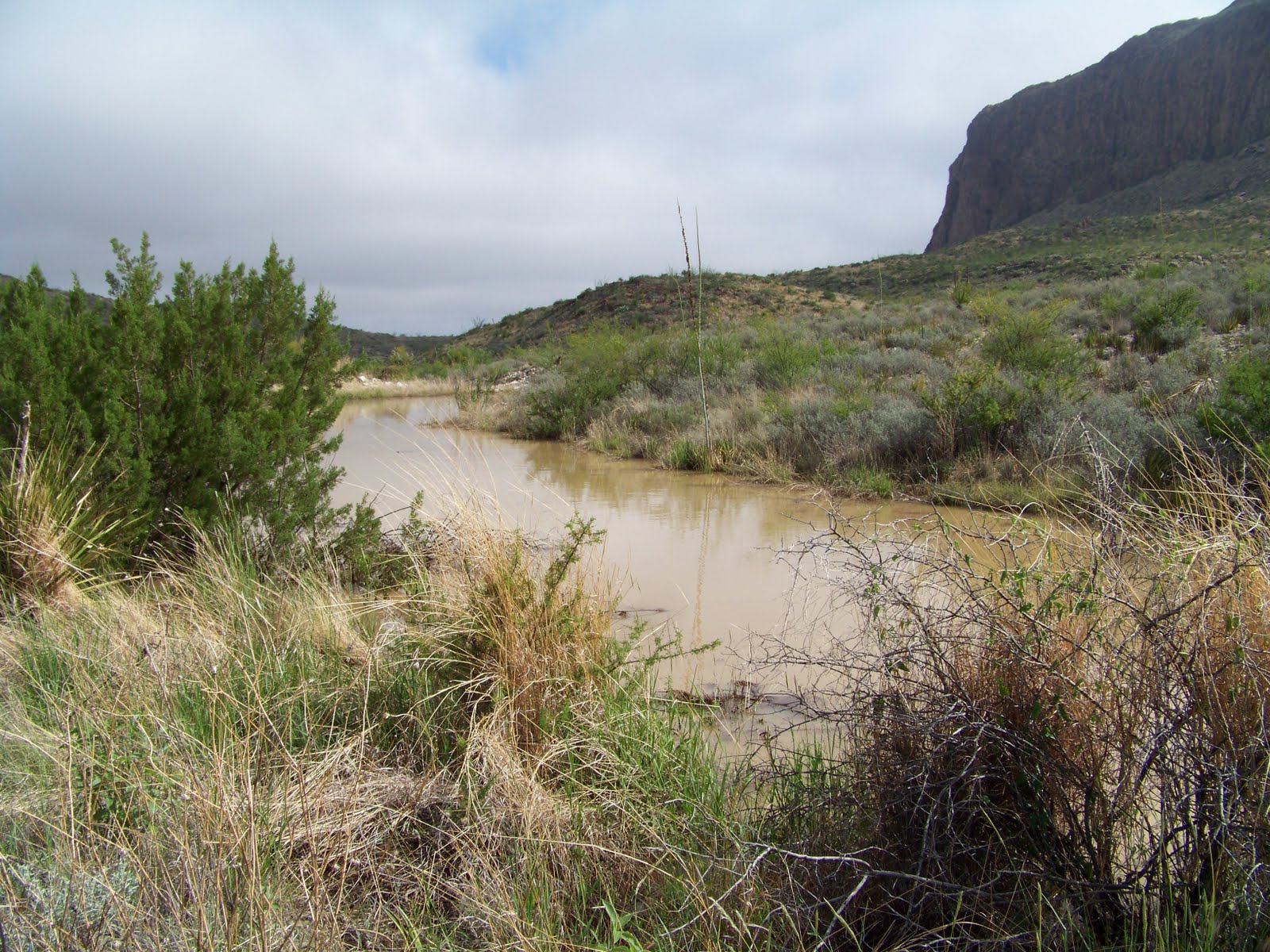
This is the lower dam where the runoff heads into a large canyon and off my property. I don't have a pump installed there anymore so I was concerned that the persimmon trees would die standing in 6 feet of water, but they continue to thrive. You can barely make them out on the left edge of the dam. Their trunks are totally submerged, but I've learned not to stress about it. They didn't grow there until the dam was built about 14 years ago.  The water will clear up in a few days, but then there'll be a mosquito issue. Since the gambusias (mosquito fish) are in my tanks and escape into the arroyo during heavy rains, they'll eventually multiply enough to take care of the problem, but for a week or so mosquitoes will be annoying, to say the least.